Service
Container Moving
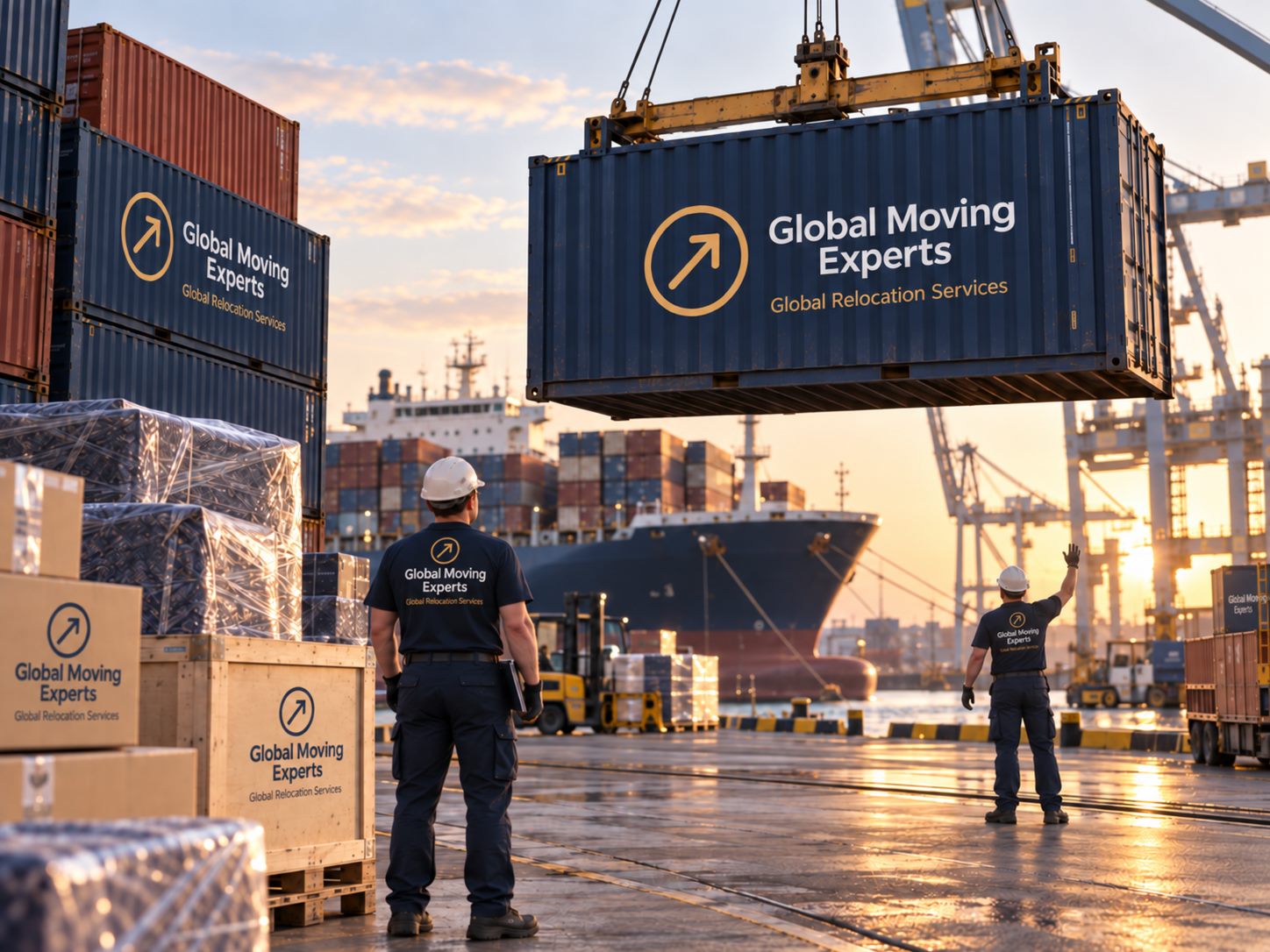
For long-distance moves — particularly overseas, where road transport is not an option — your household goods typically travel by container. Depending on your volume, that can mean a shared container alongside other households, or a dedicated container reserved solely for your shipment.
- Options
- Shared container or dedicated container
- Typical destinations
- Overseas moves — North America, Middle East, Oceania
- Pairs with
- Sea freight transport and destination customs clearance
Container moving is the usual method for relocations to destinations such as the USA, Canada, Australia, and the UAE, where sea freight bridges the distance that road transport covers within Europe.
A container move involves more distinct stages than a road move — packing, transport to the departure port, loading, the sea crossing itself, arrival and customs clearance, and finally onward delivery to your address. We coordinate all of these as one continuous process rather than a series of separate handoffs you would otherwise have to track yourself.
Container moving is also the method used for corporate relocations to overseas destinations, where a fixed employment start date makes schedule predictability especially important. In these cases, we generally recommend a dedicated container specifically to avoid the shipment being tied to another household's schedule.
Shared vs. dedicated container
A shared container works similarly in principle to groupage on the road — your goods travel alongside another household's to make more efficient use of space. A dedicated container is reserved solely for your shipment, which can simplify handling but is generally suited to larger volumes. As with road groupage, a shared container tends to make less sense once your volume approaches filling one anyway.
Packing for container transport
Because container shipments involve longer transit and more handling than a road move, packing uses export-grade materials designed to protect goods over that longer journey — see our packing service for detail. Humidity control matters more here than on a European road move, since goods may spend weeks inside a sealed container exposed to varying conditions.
Customs at destination
Most overseas destinations require customs documentation for household goods arriving by container. We help prepare the inventory and paperwork specific to your destination country — requirements differ meaningfully between, for example, US Customs and Border Protection, Canadian CBSA rules, and Australian biosecurity inspection, so we treat each destination on its own terms rather than applying one generic process.
Port handling and onward delivery
Once a container arrives and clears customs, goods still need to travel from the port to your actual address, which can be a meaningful distance for destinations not directly on the coast. We plan this onward leg as part of the overall timeline and cost, not as a separate afterthought once the container has already arrived.
Realistic timelines for container moves
Transit time depends heavily on your specific departure and arrival ports, and can range from a few weeks to well over a month depending on the route. We discuss a realistic timeline for your specific move before you commit to a date, rather than quoting a generic figure that might not reflect your actual route.
Insurance and valuable items
For higher-value shipments, or households with specific valuable items, it is worth discussing insurance coverage as part of your container booking rather than assuming a standard policy automatically covers everything at full value. We can talk through what is typically covered and where additional cover may be worth considering.
Explore more
Related services
Sea Freight
The standard transport method for overseas moves where road transport is not possible.
Learn more →Professional Packing
Full or partial packing by a team trained for international transport, not just a local move.
Learn more →Storage
Short or longer-term storage when your moving dates do not line up on both ends.
Learn more →FAQ
Container Moving — frequently asked questions
How do I know whether I need a shared or dedicated container?
It comes down to volume. We will estimate your total volume when quoting and advise whether a shared or dedicated container makes more sense for your move.
How long does container shipping take?
It varies significantly by route — we give you a realistic estimate for your specific departure and arrival ports rather than a generic figure.
What happens once my container arrives at port?
It clears customs, and then travels onward to your actual address — a leg we plan and cost as part of your overall move, not as a separate surprise afterward.
Can special items like a piano or artwork travel in a container?
Yes — these are packed with item-specific protection suited to a longer sea crossing, and flagged during the assessment stage so the right materials and container arrangement are planned in advance.
Do you handle the paperwork for container shipments, or is that my responsibility?
We prepare the documentation and inventory your specific destination requires as part of the service, rather than leaving customs paperwork for you to work out alone.
Need container moving for your international move?
Tell us about your move and we will get back to you with a personalised quote.